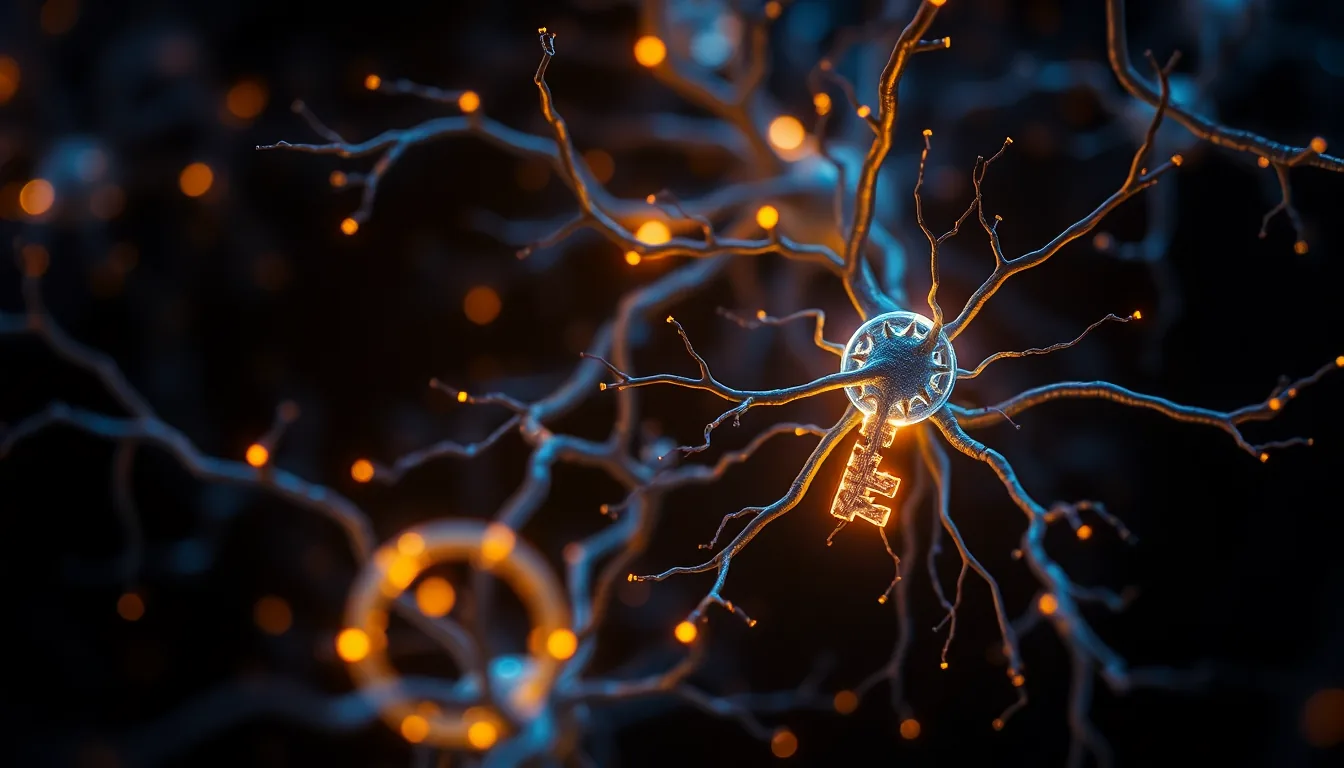
Synapses—the connections between neurons—are known to store memories, but until now we had no clear way to measure how much information they hold. A team led by Xinhao Fan at Johns Hopkins University has changed that with a theoretical framework that quantifies the information stored in synaptic strengths, not just in neural firing patterns. Published in Neural Computation, the work provides a mathematical lens for understanding memory storage in both biological and artificial networks.
The Research
Fan and coauthor Shreesh Mysore studied densely connected Hebbian networks performing autoassociative memory tasks, like recalling a pattern from a partial cue. They modeled the data patterns to be stored as log-normal distributions—a realistic representation of synaptic strength distributions. Using Shannon information theory, they derived analytical formulas for mutual information between the data and single synapses, pairs, and arbitrary groups of synapses. Their framework captured how each synapse contributes to storage, and uncovered a striking effect: the information stored by all synapses together is greater than the sum of information from each alone. This "synergistic interaction" means that the neural network encodes more information collectively than individually. The theory also matches established findings about pattern storage capacity and supports the idea of distributed coding, where information is spread across many connections.
Why It Matters
This framework formalizes something intuitively known but never precisely measured: synapses don't just store bits independently—they work together synergistically. For understanding learning and memory, this implies that we might need to consider connectivity patterns rather than just individual synapses. For artificial neural networks, it could inspire more efficient ways to store information in weighted connections. For anyone curious about their own brain, it highlights the incredible efficiency of the brain's design: our memories are distributed across billions of connections, each contributing to a whole that is smarter than its parts.
What You Can Do
While you can't measure your synapses at home, you can support brain health with regular mental stimulation, physical exercise, sleep, and a balanced diet. Keep challenging your memory with puzzles and new skills—your brain's synaptic storage benefits from variety.
Source: arXiv q-bio.NC
Curious about your own brain? Take our free adaptive IQ test or try 306 brain training levels.